A Woodpecker’s Tongue Is So Long It Wraps Around Its Brain — And It Saves Their Life
Woodpeckers are famous for hammering their heads against trees at incredible speeds. But what many people don’t realize is that behind this seemingly dangerous behavior lies one of the most astonishing biological adaptations in nature.
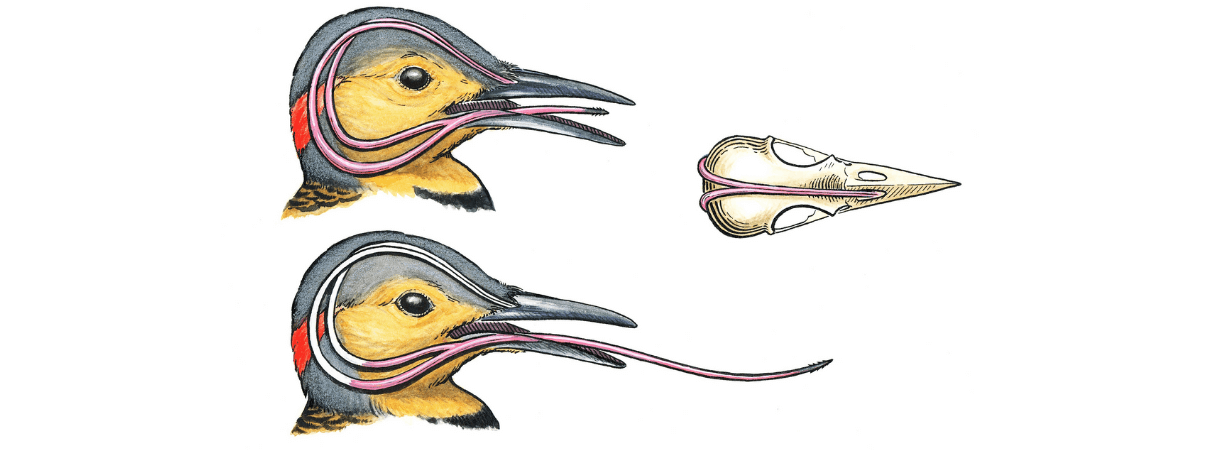
A woodpecker’s tongue is so long that it wraps around its skull — sometimes even encircling the brain — acting as a natural shock absorber that helps protect it from brain damage.
Why Woodpeckers Don’t Get Concussions
Woodpeckers can peck trees up to 20 times per second, striking wood with forces that would cause serious injury to most animals.
Yet they don’t suffer from concussions. The reason lies in a combination of:
-
Specialized skull structure
-
Spongy bone tissue
-
And most importantly — their tongue
The Incredible Tongue Anatomy
Unlike human tongues, a woodpecker’s tongue is anchored deep inside its skull.
It starts at the mouth, wraps backward around the skull, passes over the top of the head, and in some species even loops around the eye sockets.
This structure:
-
Cushions the brain
-
Distributes impact forces
-
Prevents excessive movement during pecking
More Than Just Protection
The tongue isn’t just a helmet — it’s also a powerful hunting tool.
Woodpecker tongues are:
-
Extremely long
-
Sticky at the tip
-
Often barbed
This allows them to reach deep into tree crevices to extract insects that other birds can’t reach.
Nature’s Built-In Safety System
Scientists believe the tongue functions like a seatbelt for the brain.
Every time the bird pecks:
-
The tongue tightens slightly
-
Absorbs vibration
-
Reduces shock to brain tissue
This design has inspired engineers studying impact-resistant helmets and protective gear.
Different Species, Same Genius Design
Not all woodpeckers have tongues of equal length, but most share the same core anatomy.
Species that peck harder or deeper often have:
-
Longer tongues
-
Thicker supporting muscles
-
Stronger skull reinforcement
Evolution at Its Finest
Over millions of years, natural selection favored birds that could peck without injury.
Those with better shock absorption survived longer, fed more efficiently, and passed on their genes — resulting in the remarkable woodpeckers we see today.
Why Humans Can’t Do This
Unlike woodpeckers, humans:
-
Lack flexible skull structures
-
Have short tongues
-
Cannot absorb repeated high-impact forces
That’s why even a single concussion can be dangerous for us.
The Internet Can’t Get Enough of This Fact
This fact often goes viral because it sounds unbelievable — yet it’s completely true.
The idea that a tongue can protect the brain challenges everything we think we know about anatomy.
Conclusion
A woodpecker’s tongue is not just long — it’s a life-saving biological masterpiece.
It feeds the bird.
It protects the brain.
And it proves once again that nature is the greatest engineer of all.