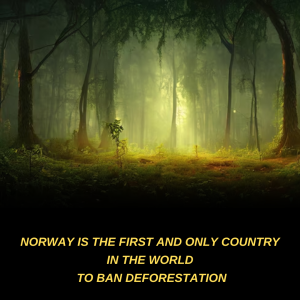
Norway and the Global Fight Against Deforestation: A Pioneering Environmental Commitment
Deforestation has long been one of the most pressing environmental issues facing the modern world. Forests are vital to maintaining biodiversity, regulating the global climate, supporting indigenous communities, and sustaining countless ecosystems. Yet every year, millions of hectares of forests are destroyed due to logging, agriculture, mining, and infrastructure development. Amid this global challenge, Norway has emerged as a leading voice for environmental responsibility, earning recognition as the first country in the world to effectively ban deforestation through its government policies and international commitments.

Understanding Deforestation and Its Global Impact
Deforestation refers to the large-scale removal of forests, typically to make way for agriculture, urban development, or resource extraction. According to environmental organizations, deforestation contributes significantly to climate change by releasing stored carbon dioxide into the atmosphere. Forest loss also leads to soil degradation, water scarcity, and the extinction of countless plant and animal species.
Tropical rainforests, often described as the “lungs of the Earth,” are particularly vulnerable. Countries in South America, Africa, and Southeast Asia experience high deforestation rates due to global demand for commodities such as palm oil, soy, beef, and timber. While many nations acknowledge the problem, few have taken concrete, enforceable steps to address their role in driving deforestation abroad.
Norway’s Landmark Decision
In 2016, Norway made international headlines by becoming the first country to commit to a zero-deforestation policy in public procurement. This decision meant that the Norwegian government pledged not to purchase products that contribute to deforestation. While Norway did not pass a single law labeled explicitly as a “deforestation ban,” its policy actions effectively achieved that goal.
The resolution was supported by Norway’s parliament and aligned with the country’s broader environmental and climate goals. It sent a powerful message: economic development should not come at the expense of the world’s forests.
What Does Norway’s “Ban on Deforestation” Really Mean?
It is important to clarify what Norway’s commitment entails. Norway has not banned all tree cutting within its borders. Sustainable forestry still exists, and trees are harvested under strict regulations that ensure regeneration and ecological balance. Instead, the policy focuses on:
-
Eliminating government procurement linked to deforestation
-
Supporting sustainable supply chains
-
Protecting tropical forests internationally
-
Reducing Norway’s global environmental footprint
In practice, this means the Norwegian government avoids buying products like palm oil, timber, soy, or paper that originate from illegal or unsustainable deforestation.
International Leadership and Financial Support
Norway’s environmental leadership goes far beyond its borders. The country has invested billions of dollars in international forest conservation through initiatives such as the Norwegian International Climate and Forest Initiative (NICFI). This program provides financial incentives to developing countries to reduce deforestation and protect natural ecosystems.
Norway has partnered with countries like Brazil, Indonesia, and Guyana, offering results-based payments when deforestation rates decline. These partnerships help fund conservation efforts, support indigenous land rights, and improve forest monitoring systems.
Why Norway Took the Lead
Several factors explain why Norway was able to take such a bold step:
-
Strong Environmental Values
Environmental awareness is deeply rooted in Norwegian society. Nature plays a central role in national identity, culture, and daily life.
-
Economic Stability
Norway’s wealth, largely derived from oil and gas, gives it the financial flexibility to invest heavily in environmental protection without compromising economic security.
-
Political Consensus
Environmental protection enjoys broad support across political parties in Norway, making long-term commitments possible.
-
Global Responsibility
As a wealthy nation, Norway recognizes its responsibility to lead by example in addressing global environmental challenges.
Impact and Global Influence

Norway’s actions have inspired other countries and organizations to reconsider their own roles in deforestation. Governments, corporations, and financial institutions increasingly adopt zero-deforestation pledges, partly influenced by Norway’s leadership.
Large companies now face greater pressure to ensure their supply chains are transparent and sustainable. Investors are also paying closer attention to environmental risks, recognizing that deforestation poses long-term economic threats.
While Norway alone cannot stop global deforestation, its policies demonstrate that meaningful action is possible when political will and public support align.
Criticism and Limitations
Despite widespread praise, Norway’s approach is not without criticism. Some environmental groups argue that the policy relies too heavily on voluntary compliance and international cooperation. Others point out that Norway’s continued oil and gas production contradicts its image as an environmental champion.
However, even critics generally agree that Norway’s forest policies represent a significant step forward and provide a model that other nations can adapt and improve upon.
The Future of Forest Protection

As climate change accelerates, protecting forests has become more urgent than ever. Norway continues to expand its environmental initiatives, investing in satellite monitoring, transparency tools, and indigenous land protection.
The country’s example shows that environmental responsibility does not require economic sacrifice when policies are thoughtfully designed. Instead, sustainability can become a foundation for long-term stability and global cooperation.
Conclusion
Norway’s commitment to banning deforestation-linked activities marks a historic milestone in environmental governance. By aligning public procurement, international finance, and environmental ethics, Norway has set a powerful precedent for the rest of the world.
While deforestation remains a global challenge, Norway’s leadership proves that change is possible. Protecting forests is no longer just an environmental issue—it is a moral, economic, and political imperative for the future of our planet.